Historical background
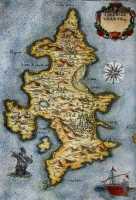
|
1.Pre-historic
and ancient times.
|
 The
name Zakynthos appears in myths and legends going back to prehistoric
times. Homer was the first to refer to the island, both in the Iliad and
the Odyssey. From Homer's "Iliad", we can conclude that Zakynthos together
with Kephallonia, Lefkada and Acarnania- was part of the domain of Odysseus,
the legendary king of Ithaca. It is said that it took its name from Zakynthus,
son of the king of
Phrygia Dardanus. Zakynthus, along with Achaean fighters, set off from
the city of Psophis in Arcadia, where his brothers reigned, to colonize
the island. He built an acropolis, probably at the location where the
Venetian castle is today, which he named Psophida. According to Pausanias
and Thucydides this happened around 1500 BC. The new inhabitants worshipped
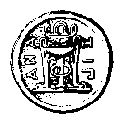
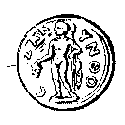
the Olympian gods, mainly Apollo and Diana, as suggested by the ancient
coins found in the area. There are no testimonies of participation by
Zakynthos in the Persian Wars of 5th century BC and it is quite likely
that the island maintained a neutral position. During the Peloponnesian
War, the Zakynthians supported the Athenian Alliance and participated
in the expedition against Sicily. After the failure of the expedition,
the Athenian Alliance was dissolved and Zakynthos was conquered by Sparta.
Later on it fell under the influence of the Macedonians, until the final
fall into the hands of the Romans. |
| 2.Roman and Byzantine times. |
 In
the 2nd century B.C., Zakynthos was under the Roman Empire. Initially
it was administered by a Roman proconsul according to the Roman Law; later
the citizens acquired a degree of autonomy with the obligation to pay
an annual tax to the Romans and to offer soldiers to man Roman legions.
Despite that, the islanders, especially in the beginning, revolted several
times against the Roman occupation. On many occasions though, they helped
the Romans to defend the island from raids, especially from pirates, who
preyed upon the coasts of the Mediterranean. During those years the island
developed both materially and culturally. The decline and collapse of
the Roman Empire, gave new impetus to several aspiring conquerors. For
decades the local population faced successive raids by Goths, Vandals
and Arabs, which brought them to the threshold of poverty. There is no
historically confirmed information about the time Christianity was introduced
to Zakynthos; we conclude that the new religion became dominant in the
second half of the 3rd century AD. Local tradition supports that Maria
Magdalene, going from Jerusalem to Rome, in 34 AD, stopped at the island
and preached the teachings of Jesus. The village where she taught, at
the west side of the island, was called Maries to commemorate this event.
During the Byzantine period the residents of Zakynthos continued to live
in poverty, without any prospect of development, because of island's location
at the periphery of the Byzantine Empire and, therefore, an easy target
of raids. At the beginning of the 2nd millennium, as the Byzantine Empire
marches towards its collapse, a new sort of raid appeared on the scene.
Under the pretext of liberating the Holy Lands, crusader troops of adventurers
and booty-hunters swarmed to invade the remotest Byzantine Counties. |
| 3.Frankish domination. |
 At
the end of 12th century AD, Frank raiders conquered the Ionian islands
and established the first Frank hegemonies in Greece. In 1185 the Palatine
County of Cephalonia and Zante was found, which survived for three centuries
under the Orsini Family in the beginning and the Tokki later. Throughout
the period of Frank rule the island's history was characterized by conspiracy,
intrigue and murder. During the Tokki hegemony, though, the living conditions
improved and the population of the island grew to 25.000 residents. In
1479 Turks conquered and destroyed Zakynthos and the last Tokkos deserted
the island, incapable of doing anything to contain the enemy's advances. |
| 4.Venetian domination. |
 The
Venetians appreciated the strategic position of Zakynthos between the
Greek and Italian mainlands and after admirable war and diplomatic efforts
they conquered the island in 1485. The Venetian domination offered Zakynthos
the stability and the opportunities for development which they were deprived
of for centuries. The decimated population only few of the islanders had
survived the Turkish domination was reinforced with Venetian citizens
and Greeks in search of refuge after their lands had been taken by the
Turks. This way Zakynthos beccame a center for the persecuted Greeks and
the center of Hellenism. The Greek consciousness and tradition interacted
with the intense Western influence and led to a new spirit which found
expression through various forms of art. As in all Venetian ruled territories,
the residents were divided in three social classes: the nobility (nobili),
the citizens (civili) and the common people (popolari). Only the nobility
had any civil rights and the members of this class were registered in
the Golden Book, the Libro d'Oro. Nobility's inhumane and insatiable rapacity
led to the social explosion known as the People's Rebellion (1628-1632).
It was the first social revolution in the history of modern Greece and
it ended in a blood bath. The message of the French Revolution (1789)
was received on Zakynthos with enthusiasm. The Jacobin Association was
formed, a political organization whose object was the political equality
with the nobility. In 1797 the Venetian authority came to end after three
centuries, as the French democrats conquered the island. |
| 5.French and Russo-Turkish periode. |
 On
July 4th 1797 the tricolor democratic flag substituted the flag of Saint
Marcus in Zakynthos. A few days later, amid demonstrations of enthusiasm
and relief, the Golden Book, the book of the noble's names and privileges,
was burnt in the square of St Marcus. The French tenure lasted only 15
months. In October 1799 the French garrison was forced to surrender by
Russians and Turks. In 1800 the two powers decided to establish an independent
state under the name "The State of the Ionian Islands" under the supervision
of Russia and Turkey. To the latter the new established state was forced
to pay an annual tax. The State of the Ionian Islands was the first independent
Greek state of modern history and lasted seven years. In 1807 the French
troops, this time under the Emperor Napoleon, conquered the Ionian islands.
Two years later, in 1809, the British navy subjugated Zakynthos. |
| 6.English protection. |
 The
British tenure (1809-1864) was the last tenure period before they united
with Greece. During this period many infrastructure works were executed,
such as bridges and part of the harbour. During the years which preceded
the Greek Revolution against the Turks, the people of Zakynthos made intense
secret preparations in order to help their fellow Greeks. This fact brought
about many conflicts between the islanders and the British administration.
Conflicts become more intense in 1821 after the outbreak of the Greek
Revolution. Willing to preserve the neutrality, the British Administration
used every means to prevent residents from supporting the Revolt. Despite
persecutions, imprisonments and hangings, the Zakynthians actively supported
the rebellious Greeks. After the liberation of Greece and the establishment
of the Greek State, the Ionian islands claimed their unification with
Greece. Despite its strong objection, Britain together with France and
Russia signed on June 5 1863, in London, the Treaty according to which
Britain gave up its role as the power protecting the Ionian Islands. On
May 21st 1864 the unification of the Ionian Islands with Greece became
official. |
| 7.Recent years. |
 Now
a part of Greece, Zakynthos and the other Ionian islands shared the course
of history with the rest of the country. During Word War II, the island
was to be subjected along with the rest of the country, to occupation
by the Italians and the Germans. Many islanders participated in the resistance
against the occupying army and after much conflict and sacrifice the island
was liberated from German Occupation in 1945. A few years later, in 1953,
a terrifying earthquake shook the islands of Ionian Sea causing massive
destruction to Zakynthos. Nearly all of Zakynthos old mansions and churches
were razed to the ground. The flattened capital was rebuilt under strict
anti-earthquake regulations, endeavoring to retain the character of the
old town. |